
Introduction
Flyers remain a practical and effective way to promote businesses, products, services, and special events. Printing for Less flyers can be a useful search starting point for businesses looking for professional printing solutions, attractive designs, and cost-effective marketing materials. Whether you are a small business owner, event organizer, or marketing professional, choosing the right flyer size, paper quality, printing method, and design can help you communicate your message effectively.
Professional flyer printing combines clear design with quality materials to create promotional content that people can easily read and remember. From simple promotional handouts to full-color business flyers, the right printing choices can help your brand make a positive first impression.
What Is Printing for Less Flyers?
Printing for Less flyers refers to the process of producing promotional printed materials through professional printing services, including options associated with the Printing for Less brand. Flyers are single-sheet marketing materials used to share information about products, services, sales, events, and business announcements.
Businesses commonly use flyers to reach local customers, introduce new products, advertise special offers, and promote upcoming events. They can be distributed in stores, included in shopping bags, displayed on community noticeboards, or handed directly to potential customers.
Printing for Less is an established online commercial printing company that has provided printing services since 1996. Its website also offers printing resources covering design preparation, paper descriptions, and flyer printing examples. Customers should check the company’s current product catalogue and contact its team to confirm available flyer specifications and pricing.
A well-planned flyer should communicate its main message quickly. It needs an attractive headline, readable text, relevant images, and a clear call to action.
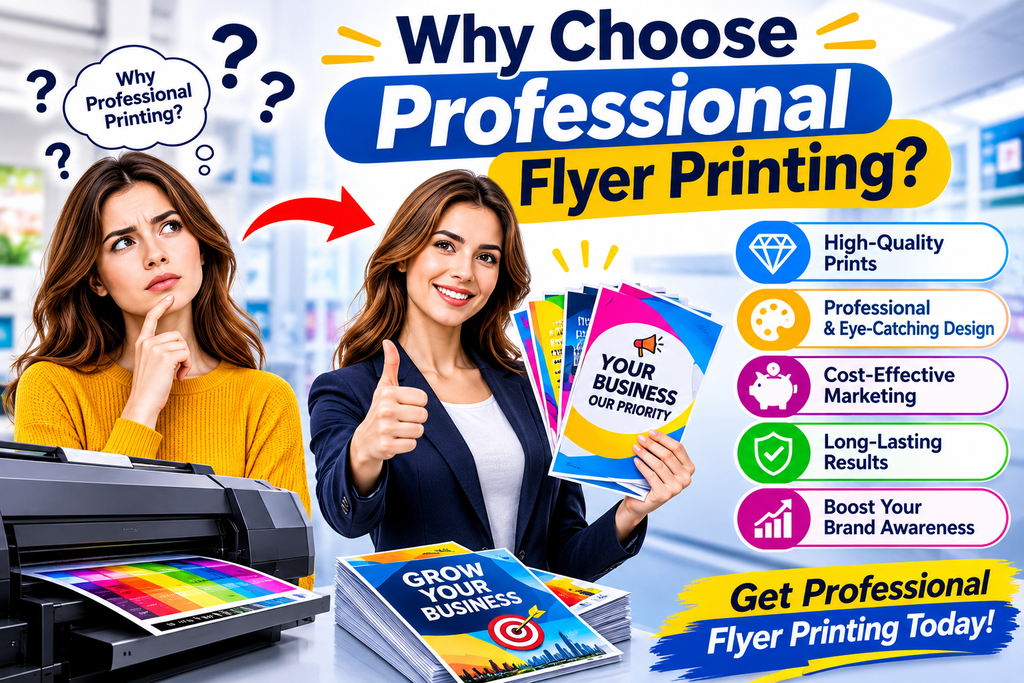
Why Choose Professional Flyer Printing?
Professional flyer printing can help businesses produce consistent, attractive marketing materials without depending entirely on ordinary office printers. Commercial printing is particularly useful when a business needs larger quantities, accurate colours, or a more polished finish.
1. Better Print Quality
Professional printing equipment is designed to produce consistent results across multiple copies. High-quality printing can improve image clarity, colour appearance, and text readability.
This is especially important for businesses that use product photographs, detailed graphics, or brand colours in their promotional materials.
2. Consistent Branding
Flyers are often part of a wider marketing strategy. Using consistent logos, fonts, colours, and design elements helps customers recognize a business across different marketing channels.
For example, a restaurant can use the same branding on its menu, promotional flyers, social media graphics, and website.
3. Suitable for Different Marketing Campaigns
Businesses can create flyers for different purposes, including seasonal promotions, product launches, store openings, special discounts, and community events.
A flexible design makes it easier to update promotional information for future campaigns.
4. Convenient Bulk Printing
When a business needs hundreds or thousands of copies, commercial printing may be more practical than producing every flyer individually using an office printer.
The most suitable option depends on the required quantity, turnaround time, paper selection, and printing budget.
Different Types of Flyers Available for Printing
Selecting the right flyer format is an important part of planning a successful marketing campaign. Different formats serve different purposes, depending on the amount of information and the intended audience.
Single-Sided Flyers
Single-sided flyers contain promotional information on one side of the paper. They are suitable for simple advertisements, discount announcements, event invitations, and short business promotions.
Because all information appears on one side, the design should focus on a single main message. A strong headline, attractive image, short description, and contact details are usually sufficient.
Double-Sided Flyers
Double-sided flyers provide additional space for promotional content by using both sides of the paper.
The front can introduce the main offer, while the reverse side provides supporting information, product details, business contact information, or terms and conditions.
This format is useful for businesses that need to communicate more information without choosing a larger flyer size.
Folded Flyers
Folded flyers provide multiple panels for organizing information. They are useful for businesses that want to present product descriptions, service details, schedules, or promotional information in a structured format.
Common folding styles include:
- Half-fold flyers
- Tri-fold flyers
- Z-fold flyers
A folded format can make promotional content easier to organize, but the design must account for panel sizes and folding positions.
Custom Business Flyers
Custom business flyers allow companies to create promotional materials that reflect their branding and marketing objectives.
A real estate agency might use property photographs and contact details, while a fitness centre might promote membership packages, class schedules, and introductory offers.
Custom flyer printing is useful when standard layouts do not provide enough flexibility for a specific campaign.
How to Choose the Right Flyer Paper and Size
Paper selection and flyer dimensions can influence the overall appearance, durability, and usability of printed marketing materials.
Before placing an order, consider the purpose of your campaign, distribution method, design requirements, and budget.
Popular Flyer Sizes
Some commonly used flyer sizes include:
| Size | Dimensions | Common Uses |
|---|---|---|
| A4 | 210 × 297 mm | Detailed promotions and product information |
| A5 | 148 × 210 mm | Business promotions and event advertising |
| A6 | 105 × 148 mm | Small promotional handouts |
| DL | 99 × 210 mm | Offers, announcements, and inserts |
A5 is a useful choice for general business promotions because it provides enough room for a headline, image, offer, and contact information. A6 works well when portability and simple messaging are priorities.
Understanding Paper Weight
Paper weight is commonly measured in grams per square metre (GSM). A higher GSM generally indicates heavier paper, although the final feel also depends on the paper type and coating.
Common options include:
- 130–150 GSM: Suitable for lightweight promotional leaflets.
- 170–200 GSM: A useful middle option for more substantial flyers.
- 250–300 GSM: Suitable for thicker promotional materials and premium presentations.
These are general examples rather than guaranteed specifications from a particular printing company. Always confirm available paper weights before ordering.
Choosing the Right Finish
The paper finish can change how a flyer looks and feels.
- Gloss finish: Adds shine and can make colourful images appear more vibrant.
- Matte finish: Creates a softer appearance with less surface reflection.
- Uncoated finish: Provides a natural paper texture and is often easier to write on.
Choose a finish that matches your design. For example, a colourful product advertisement may benefit from gloss, while an informational flyer may work better with an uncoated or matte surface.
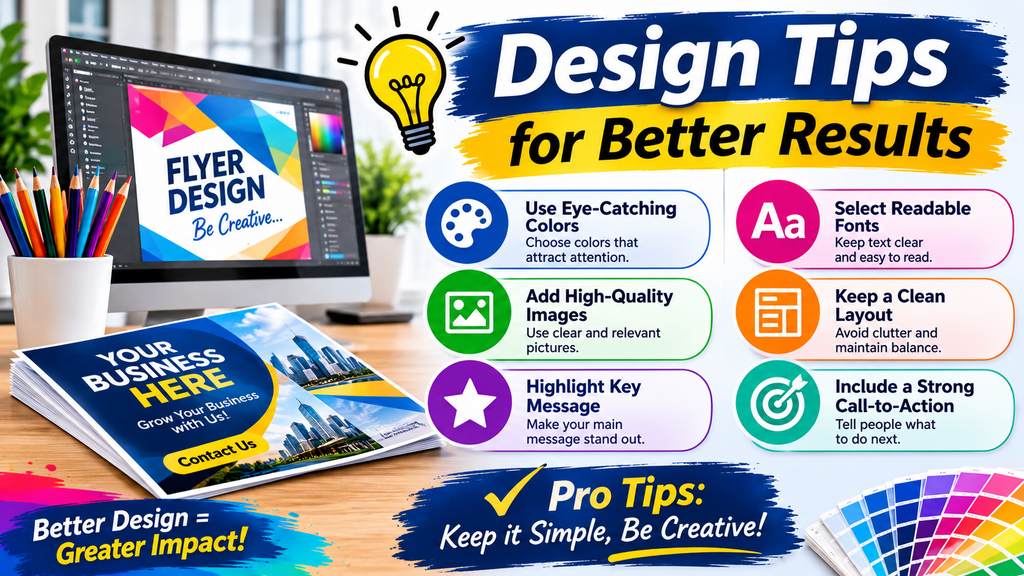
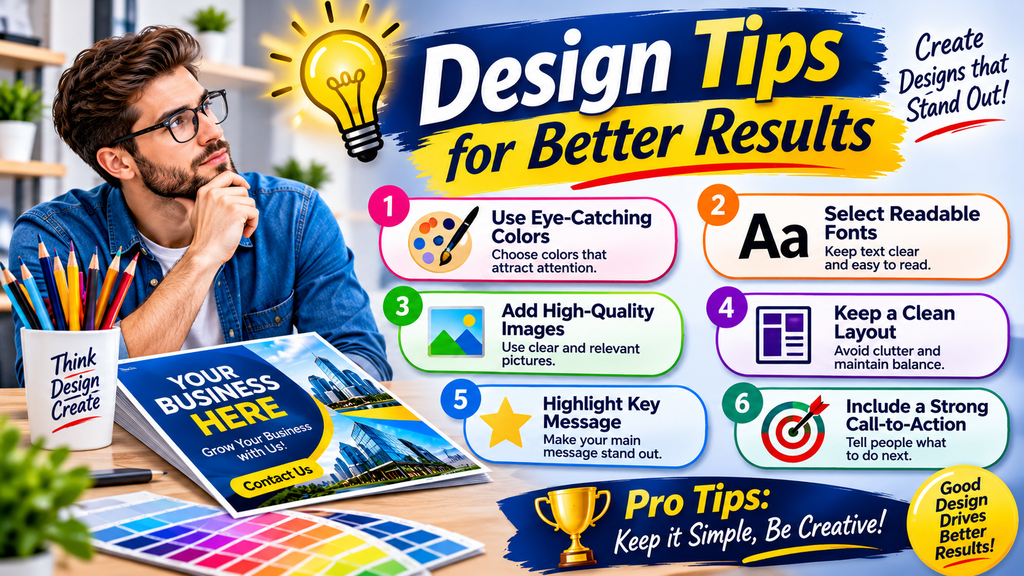
Printing for Less Flyers: Design Tips for Better Results
An attractive flyer is not simply about using bright colours or adding multiple images. Effective flyer design requires a clear message, balanced layout, readable typography, and a strong visual hierarchy.
Start With a Strong Headline
The headline should immediately explain what the flyer is promoting. Avoid vague titles that do not communicate a clear benefit.
For example, a headline such as “Save on Your Next Home Cleaning Service” is more informative than simply writing “Special Offer.”
Use High-Quality Images
Images help readers understand the product, service, or event being promoted. Use clear, relevant images that support the message instead of distracting from it.
Low-resolution photographs can appear blurry when printed, so prepare suitable image files before submitting your design.
Keep the Layout Simple
Too much information can make a flyer difficult to read. Organize the content into clear sections and leave enough white space around important elements.
Use a consistent font style and avoid combining too many colours or decorative elements.
Add a Clear Call to Action
A call to action tells readers what they should do next. Examples include:
- Visit our website.
- Call today for more information.
- Register for the upcoming event.
- Shop now and explore the offer.
Make the call to action noticeable and include the correct website address, telephone number, or other relevant contact information.
How Much Does Flyer Printing Cost?
Flyer printing prices depend on several factors, so there is no single price that applies to every order. The final cost generally changes according to the selected specifications and production requirements.
Important pricing factors include:
- Quantity: The number of flyers required can affect the overall price and cost per copy.
- Size: Larger formats may require more paper and production resources.
- Paper weight: Heavier paper stocks can cost more than lightweight alternatives.
- Printing sides: Double-sided printing may cost more than single-sided printing.
- Colour: Full-colour printing and special colour requirements can affect production costs.
- Finishing: Lamination, special coatings, and other finishing options may increase the total cost.
- Delivery: Shipping method and delivery location can influence the final order amount.
Digital printing is often suitable for smaller quantities and projects that need flexibility. Offset printing may be more economical for some larger production runs, depending on setup costs and specifications.
To manage your budget, compare the complete order cost rather than looking only at the price per flyer. Also check whether shipping, design assistance, and additional finishing services are included.
For Printing for Less specifically, review the current official pricing and product information before making a purchase decision.
Benefits of Using Flyers for Business Marketing
Despite the growth of digital advertising, printed flyers continue to offer practical marketing opportunities. They allow businesses to communicate directly with potential customers in physical locations.
Local Audience Reach
Local businesses can distribute flyers in areas where their target customers live, work, or shop. This can be useful for restaurants, retail stores, cleaning companies, gyms, and service providers.
Product and Service Awareness
Flyers provide an easy way to introduce a new product, explain a service, or communicate a special promotion.
A well-designed flyer can present important information in a compact and accessible format.
Event Promotion
Community events, workshops, exhibitions, and business openings can benefit from printed promotional materials. Flyers can include event dates, locations, registration details, and contact information.
Support for Other Marketing Channels
Printed marketing materials can work alongside websites, email campaigns, and social media promotions.
For example, adding a QR code to a flyer can direct readers to a landing page, online booking form, or product catalogue. This creates a connection between offline promotion and digital engagement.
How to Prepare Your Flyer Design for Printing
Preparing a print-ready file correctly can help prevent common production problems.
Before submitting your artwork, follow these steps:
1. Choose the correct document size. Set your design dimensions according to the printer’s selected flyer format.
2. Use high-resolution images. Images intended for commercial printing are commonly prepared at 300 DPI at their final printed size.
3. Set the correct colour mode. CMYK is commonly used for full-colour commercial printing. RGB colours may look different when converted for print.
4. Include bleed. Bleed extends background artwork beyond the final trim edge. A 3 mm bleed is a common requirement, but always follow the printer’s specific template.
5. Maintain a safe area. Keep important text, logos, and contact details away from the cutting edge to reduce the risk of accidental trimming.
6. Check fonts and spelling. Embed or outline fonts according to the printer’s file requirements and review all written content carefully.
7. Export the correct file format. A print-ready PDF is commonly accepted by commercial printers. Confirm the required export settings before uploading.
Taking time to review these details can reduce errors and help your flyers look professional.
Common Flyer Printing Mistakes to Avoid
Even a well-designed flyer can lose its effectiveness when important details are overlooked.
Avoid these common mistakes:
- Using blurry or low-resolution photographs.
- Including too much text in a small space.
- Choosing colours that make text difficult to read.
- Forgetting important contact information.
- Placing text too close to the trim edge.
- Using inconsistent fonts and branding.
- Selecting paper that does not suit the intended purpose.
- Failing to review the final proof before approving production.
A final design review should include checking spelling, prices, promotional dates, website addresses, QR codes, and telephone numbers.
Printing for Less Flyers vs. DIY Printing
Businesses can produce flyers themselves using home or office printers, or they can use professional commercial printing services. Both approaches have advantages depending on the project.
| Factor | DIY Printing | Professional Printing |
|---|---|---|
| Initial setup | Often convenient | Requires an order process |
| Small quantities | Can be practical | Depends on minimum quantities |
| Large quantities | Can take considerable time | Often more practical |
| Paper selection | Depends on printer | May offer more choices |
| Print consistency | Depends on equipment | Designed for production consistency |
| Finishing options | Usually limited | May include specialist options |
DIY printing can work for internal notices, quick drafts, or very small quantities. Professional printing is generally worth considering when businesses need larger quantities, consistent branding, and a more polished presentation.
The right choice depends on the campaign’s budget, quantity, deadline, and quality expectations.
FAQ
1. What are Printing for Less flyers used for?
Flyers are printed marketing materials used to advertise products, services, special offers, business events, and announcements. They help businesses share information with potential customers through physical distribution.
2. What is the best size for business flyers?
A5 is a popular general-purpose size because it provides room for promotional text and images without being difficult to distribute. A6 is suitable for smaller handouts, while A4 is useful for more detailed information.
3. Is double-sided flyer printing worth it?
Double-sided printing can be useful when you have more information than can comfortably fit on one side. It provides extra space for product details, contact information, offers, and supporting content.
4. What paper weight is best for flyer printing?
The best paper weight depends on the intended use. Lightweight paper can work for mass distribution, while heavier stocks may create a more substantial presentation. Compare available GSM options before ordering.
5. How can I reduce flyer printing costs?
You can manage printing costs by choosing an appropriate size, comparing paper options, selecting a suitable quantity, and avoiding unnecessary finishing. Compare the complete order price before making a decision.
6. What file format should I use for printing flyers?
A print-ready PDF is commonly used for commercial flyer printing. Your file should follow the printer’s requirements for dimensions, bleed, resolution, colour mode, and fonts.
7. Are printed flyers still effective for marketing?
Yes. Printed flyers can help businesses reach local audiences, promote special offers, and support digital campaigns. Their effectiveness depends on the quality of the message, audience targeting, design, and distribution strategy.
Final Thoughts
Printing for Less flyers can be a useful starting point for businesses researching professional printing solutions and promotional materials. Choosing the right flyer format, paper quality, design, and printing method can help create marketing materials that communicate clearly and represent a brand professionally.
Before placing an order, consider your campaign objectives, target audience, budget, and distribution method. Prepare your artwork carefully, check the printer’s current specifications, and review the final proof before production.
Whether you need simple promotional handouts, custom business flyers, or detailed marketing materials, a well-planned printing project can support your wider marketing strategy and help your business connect with potential customers.